Jake Green, Head of Technical Engagement at Scolmore Group - which includes the Orbik emergency lighting range by Ovia - examines what the 2025 updates to BS 5266‑1 mean for emergency lighting designers and installers.
The updating of the emergency lighting code of practice, BS 5266-1: 2016, to the 2025 version has recently been published. This update follows the amendments to the related EN standards EN 1838 (Lighting applications. Emergency lighting for buildings), and EN 50172 (Emergency escape lighting systems), both of which were published in 2024.
This article highlights some of the changes made to the standard. However, it should be noted in general that some notes have become clauses, and some clauses have become notes.
Emergency lighting functions
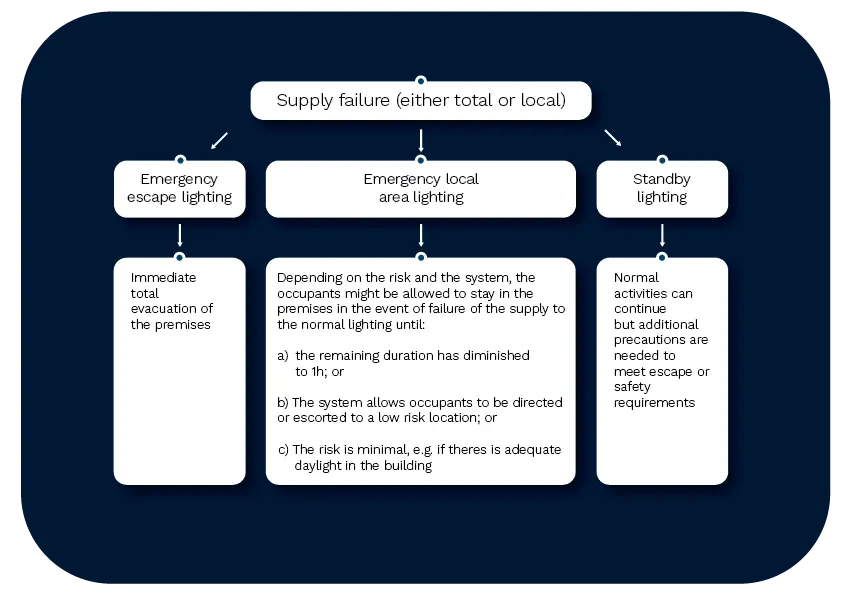
The 2025 edition has added emergency local area lighting (formerly ‘emergency safety lighting) which provides lighting for safe movement in premises when the occupants do not need to evacuate the premises immediately.
Figure 1 (below) of the standard has been updated to detail this change.
Supply of plans
Clause 4.2 has incorporated the recommendations in BS EN 50172 for the supply of plans to include escape route signs and special locations.
Defined escape routes (5.2.5)
There has been a slight change to the minimum recommendations regarding the floor level illuminance in defined escape routes. The minimum level is now to be 1 lx across the whole escape route width. However, the border up to 0.5 m may be excluded. Where the defined escape route is less than 2 m, the borders of ¼ of the escape route width should be excluded.
Open areas (5.2.6)
Open areas over 60 m² still require 0.5 lx minimum illuminance. However, where an escape route passes through an undefined open area, the entire space must now be treated as an escape route, raising the minimum illuminance to 1 lx. EN 1838 continues to provide supporting detail.
High-risk task areas (5.2.7)
The recommendations regarding high-risk task areas to have a minimum illuminance level of 10 % remains. However, the 2025 standard recommends that the illuminance is never less than 15 lx at the location of the point of risk.
Siting of luminaires and special locations (5.2.8.1)
This clause has been expanded significantly. Emergency escape lighting must now be provided at points of emphasis including:
- externally illuminated escape route signs and safety signs
- each change of direction
- external routes leading to a place of ultimate safety
- lift alarm call points and winding facilities
- corridors from lift doors to escape routes
- firefighting equipment and call points, with 5 lx vertical illuminance
· first aid posts, also requiring 5 lx vertical illuminance
External areas in the immediate vicinity of exits (5.2.8.2)
The standard now refers specifically to places of ultimate safety. Performance requirements for external areas and assembly points should be defined within the building’s fire risk assessment and evacuation plan
Toilet facilities and changing rooms (5.2.8.5)
Recommendations have been broadened. Areas over 8 m² require anti‑panic lighting and escape route illuminance (1 lx). Single‑occupancy toilets with baby changing facilities must provide 5 lx at the changing mat, and accessible toilets must achieve 5 lx at floor level. Multi‑closet accessible facilities must include emergency illumination from at least one luminaire.
Public indoor swimming pools (5.2.8.8)
A new clause recommends 5 lx minimum illuminance on the water surface, circulation areas and pool surrounds, referencing BS EN 12193:2018.
Distance factors and viewing distance for sign identification (5.2.9.1.3)
Clause 5.2.9.1.3 has been updated and has had a title change. Reference is still made to BS 5499-4:2013 Table 3 and Table 2.
Other externally illuminated safety signs (5.2.9.2)
Clause 5.2.9.2 now combines the previous recommendations of 52.9.2.1 and 5.2.9.2.2 and simplified the clause.
Power supplies and equipment used as electrical sources for safety services (ESSS) (7)
The commentary clarifies that the ESSS is exclusively for supplying emergency escape lighting during normal power failure. Clause 7.1.1 emphasises that ESSS must remain operational even if a fault occurs in a dedicated safety circuit, and designers should apply independent ESSS for each safety service.
Systems must be rated in both watts and volt‑amperes, considering power factor, inrush current and any future load changes. UPS systems must follow manufacturer instructions and comply with BS 7671 Regulation 560.11 and BS 8519. Power supplies must be accessible only to skilled or instructed persons and adequately ventilated.
Wiring systems and circuits (8)
Section 8 has been substantially rewritten. Clause 8.2.1 now lists designer responsibilities, including continuity of supply and situations where looping in/out of luminaires is not possible. Cable type recommendations remain broadly consistent, but premature collapse requirements now reference BS 7671. Clause 8.2.14 requires emergency lighting cables to be clearly identified by colour or marking at every connection.
Design procedure (10)
Several new checks have been added, including assessment of disability glare (10.3) and procedures for prolonged system shutdown (10.4). Handover documentation (10.7.2) is now more detailed, providing a comprehensive checklist.
Certificates and logbooks (11)
Commissioning inspections and tests from BS EN 50172:2024 must be included in handover documentation. Variations from BS 5266‑1 must be recorded. Photometric verification is now required initially and at intervals not exceeding five years to ensure ongoing system performance.
Conclusion
The 2025 update introduces meaningful changes across illuminance levels, documentation, siting requirements and verification intervals. Designers, installers and responsible persons should familiarise themselves with the revised standard to ensure compliance and maintain robust emergency lighting provision.